Event
2
min
Introducing Analyst Notes: Knowing When Not to Trust the Model

Don Wood
CRO

Alternative data platforms have gotten very good at building models. What they don’t do as well is tell you when those models shouldn't be trusted.
That's the gap Analyst Notes is built to close.
Our forecasts are calibrated against years of historical KPI performance. When the world stays consistent, that historical performance can be a powerful predictor. However, when it doesn't, even the most finely-tuned models can quietly mislead.
There are several situations where even well-calibrated models might mislead due to incomplete information, such as:
In many of these cases, our research team has been able to identify the problem. However, until now, that knowledge was communicated through one-on-one conversations or, too often, through post-mortems after a forecast miss.
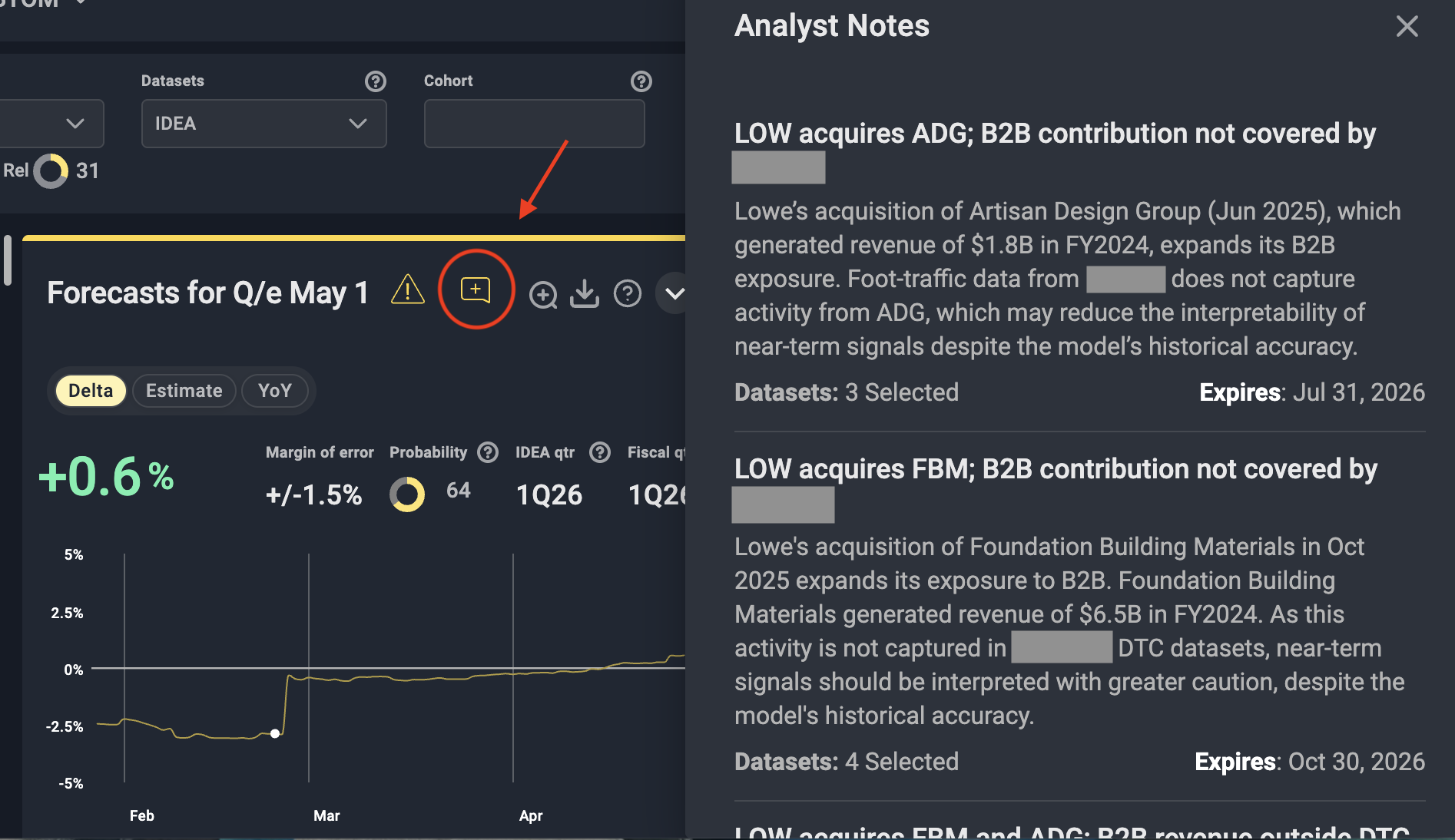
Analyst Notes is a new feature inside our flagship product, IDEA, that flags exactly when and why a prediction might be unreliable due to information that wasn’t accounted for.
These flags include short commentary written by Maiden Century research analysts so you know not only that there’s incomplete information, but what that information is. Analyst Notes identifies:
Notes auto-expire once our models have had time to recalibrate against the new reality.
The level of granularity matters. If Dataset F tracks Company A only, but Dataset G tracks both A and the company A just acquired, the note only surfaces for clients entitled to Dataset F. Clients on G already capture the change in their data, so they don't need the alert. This entitlement-aware design keeps signal high and noise low.
Currently, you can see these notes in IDEA. Notes appear as a small note icon on Ticker Summary and Screens pages. Pull up tickers like ULTA, DKS, or HD to see live examples. The full library is also viewable from your Profile page.
In email. Newly published notes are surfaced inside the daily and weekly alerts you already receive. We're not sending a new standalone email. You can adjust filters via Profile > Alerts.
Coming soon. Analyst Notes will extend across the rest of the Maiden Century stack:
.gif)
There's a deliberate one-day lag between when an analyst writes a note and when it reaches clients. That delay does two things. It gives our senior team time to review for accuracy and clarity, and it protects clients who flagged the underlying issue to us in the first place. If your conversation with our research team prompted a note, you won't see your insight arbitraged away the next morning.
For discretionary investors: Trust is the whole game. You pay for high-quality outputs, and you need to know when to lean in and when to dig deeper. Analyst Notes turns institutional knowledge that used to live in one-off conversations into something systematic.
For quants: Quants typically lack the fundamental context that catches these breakdowns, and most quant workflows want point-in-time data they can backtest. As history accumulates, Analyst Notes becomes a feed you can incorporate directly into your models, replicating the kind of fundamental overlay that's historically been difficult to systematize.
For our data vendors: When a forecast built on your data is inaccurate, you often catch the blame. Analyst Notes gives vendors cover. The note is on the record, attributable to a specific research call, and explains exactly what the data is and isn't capturing.
One client put it well in early feedback: they're already planning to feed Analyst Notes into their internal LLM as contextual input, so any interpretation of our data (or anyone else's) gets the right caveats baked in.
At the moment, none of the platforms we compete with (Carbon Arc, Arb Insights, Exabel, System2) has launched anything like this. One of the biggest reasons we were able to launch Analyst Notes is because of our incredible team — it is the visible output of a research team that has spent years learning the nuances of how each dataset interacts with each company's business and reporting.
This isn’t something you can replicate with better ETL or a smarter model — it's the human layer that turns alternative data into something you can actually trust.
A detailed guide on Analyst Notes is available on request. If you have questions or would like to chat about the feature, reach out to the Maiden Century Client Success team. We’re here to help you integrate these insights into your workflow and make the most of your alternative data strategies.
About Maiden Century
Maiden Century is an alternative data aggregation platform dedicated to providing cutting-edge insights for institutional investors. Our platform helps streamline and optimize the investment process through intuitive analytics, comprehensive datasets, and expert support. Visit maidencentury.com to learn more.
Analyst Notes is live in IDEA today for all clients at no additional cost. Have feedback or want to flag a situation you think warrants a note? Reach out to your Maiden Century contact.